Reconnecting with Kuldevi: A Spiritual Awakening
Reflections on a Transformative Voyage
Introduction
To reconnect with your Kuldevi after 4 decades; it is a feeling overbore with guilt, anxiety and palpable expectation. How will the journey unfold? Will there be challenges? Will there be unexpected obstacles? Even before leaving England, we laid all these questions to Amba and left home with a hopeful tone.
Arrival: First Impressions
We first reached our home in Mumbai – coming back after 3 years, the longing feeling finally went away and a different level of comfort blanketed us. In England, the comfort that surrounds you is completely materialistic, the one in Bharat is that of familial maternity. Despite the high traffic, redevelopment projects every 100 meters, the crowd multiplied
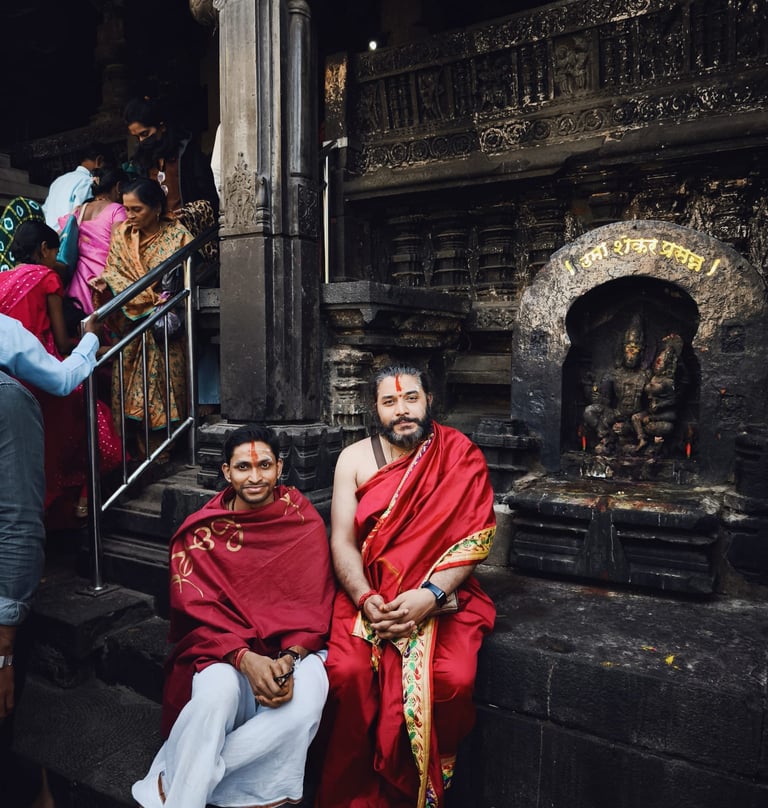
by 10x the chaos renders order to your psyche. The familiar chaos of maternity.
Kolhapur: Reknitting the maternal bond
Our pilgrimage began by boarding the overnight Mahalakshmi Express from Mumbai to Kolhapur. The overall upgradation of Indian Railways was quite pleasant. While the crowds weren’t reduced but the discipline of the staff, relative punctuality of the train service was to be commended. We reached Kolhapur around 7 am and reached our guest house, in a quiet residential area of Kolhapur.
Narsimha Wadi: Sadguru Tattva
We first visited Narsobachi Wadi or Wadi as its famously known among the locals. This Sthala is the place where Shri Narsimha Saraswati did intense Tapas at the base of an Audumbar Tree, at the banks of the sacred Krishna River. There, we rendezvoused with our dear friend, who promised to lead our small yatra at Wadi. Per our friends’ instructions, we washed off our hands and feet at Krishna River. The sense of maternal familiarity again swept me, this time it was as if a mother is offering a glass of sweet, cold, pristine water on a hot Indian summer afternoon. We got the Paduka Darshan after which we spent some time doing Dhyana. The Kshetram vibrates with the Sadguru Tattva that calms and clarifies your mind of any mental dilemma you have about any topic. It’s as if Datta Maharaj is telling you to stay still, so that you may shake off any worthless things off you to reveal your path.
After this experience, we had a sumptuous lunch at one of the many eateries that included a Thali which had the trademark Krishna Kaathchi Wangi (Brinjals from the banks of Krishna). The lunch was topped off with Basundi from Krishna sweets. I tasted the Sitaphal flavour, served in a small cup. The flavour was so gentle, which reflected the Sattvik vibe of the Kshetra. With this flavour still afresh, we began our next leg of the journey, towards Khidrapur. The Kshetram taught us the lesson of identifying and resonating with Guru Tattva.
Khidrapur: Rage of Sadness
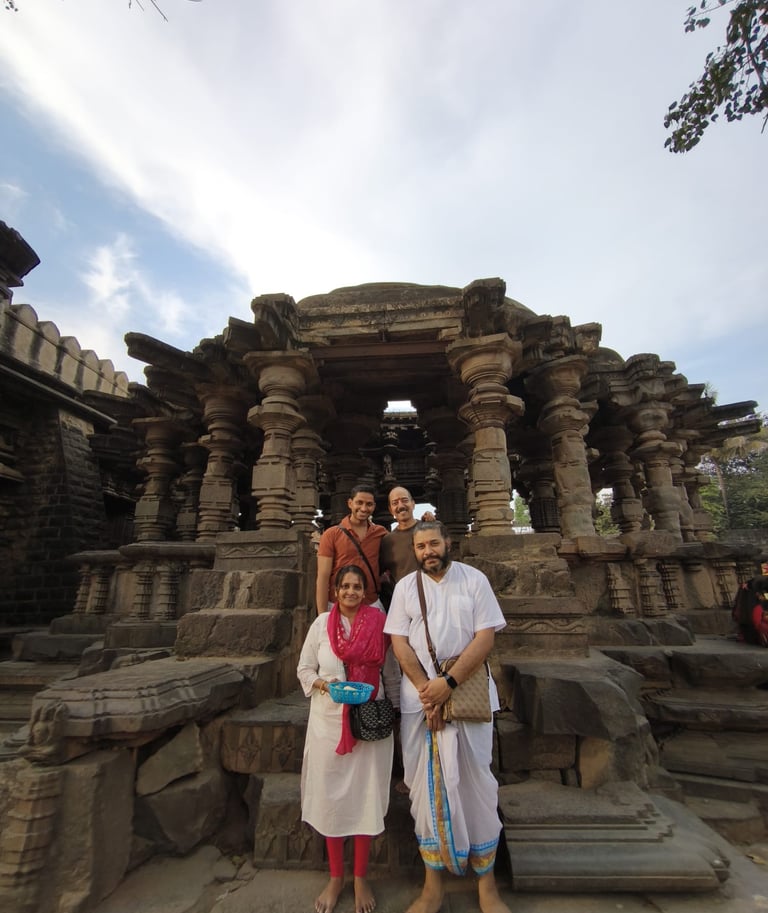
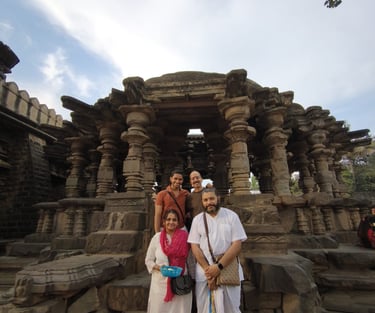
It was this Kshetra where Shri Hari Vishnu brought his dear friend, Shiva after he was mourning for his wife Sati’s immolation. When Shiva realised it was Vishnu who broke Sati’s Parthiva (corpse) into 51 pieces (now known as Shakti Peethas), he was enraged, sad and frustrated. Hence, you see both these Devatas in Linga Swarupam. The rage and sadness of Shiva is felt intensely. The temple itself is built beautifully with an ornate Sabha Mandapam that had formed the backdrop of many movies. However, the vibe of this Kshetram is that of sadness, loss and the intensity of love between Shiva-Shakti. It is but natural to be taken over by these, even if no one knows about the lore.
With permission from the caretakers, we chanted Shri Rudram and Vishnu Sahasranamam which charged us like a 125W charger juices up a mobile phone in 15 mins. With this charge and some fresh tea, we headed out for the Sandhya Aarti at Mahalakshmi Amba temple. This Kshetra showed us the impact of divine sorrow and rage but pacified by a fundamental feeling of friendship.
Mahalakshmi: First Darshan
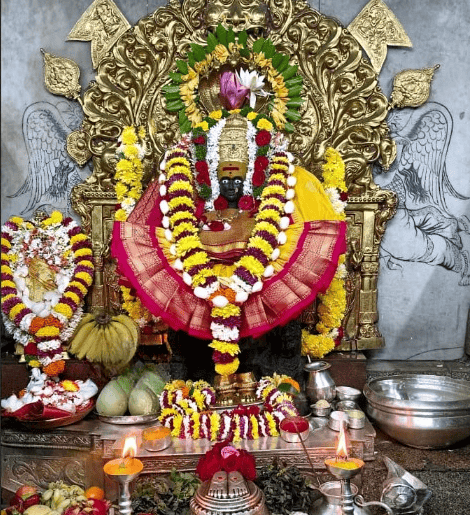
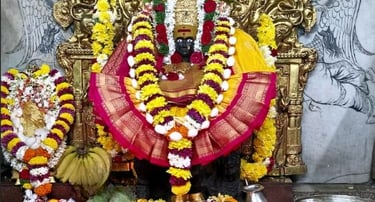
Despite being a weekday, the Sabha Mandapam was packed with devotees. Fortunately, one of the main Acharyas had been a dear acquaintance for almost 2 years. He ensured that we get as close to the Garbhagudi as possible before the Deep Aarti and then we saw her. Sati’s Netra fell at this Kshetram and this is where she slayed the Asura, Kolasura, through which Kolhapur got its name. Her eyes were piercing, kind, attentive and unmoving. Her Mangalsutram shone bright like the Arundhati Vasishtha on an Amavasya night. Her saree, a deep green in colour reflected her ever giving and comforting demeanour. Her Abhya mudra dispelled all and any doubts, wishes, conundrums, anxiety I had before seeing her. With her eyes, she was asking, “It’s been a while my child, let me see you properly”.
The Aarti was over as soon as it began. It was perhaps the spell in which we were bound by Amba, that we didn’t realise how long it went. Our friendly Acharya, Shri. Thanekar came to see us for the first time in person in 3 years and handed the first Prasad of the evening. Tears of joy rolled down our eyes as we accepted it with as much humility as I could muster and bowed to him. After the pleasantries, the volunteers started cleaning the Sabha Mandapam for which, we too got an opportunity. We then sought to see the associated Bhairava of Amba.
The Acharya was kind enough to escort us out to the Bhairava temple nearby, called Ranka Bhairava, called so due to His proximity to the Lake Rankala. Contrary to Amba’s abode, this temple was completely empty. Bhairava inspected us with his trademark sternness, to which all 3 of us bowed down to let him know, we are here for his and Amba’s Darshan. No ulterior motive in sight or mind. The next minute he felt reassured and granted us another passage to Amba. There was no flicker of doubt in my mind as to why He’s called Kshetrapala, the entire Garbha Gudi and the temple itself was surrounded by a force field of his stern protection.
Mahalakshmi: Second Darshan and Abhishekam
The next day, we arrived for the mid-morning Aarti and Tridevi Darshan. This time, we observed the Devi tattva in three Gunas, as described in Durga Saptashati – MahaSaraswati representing Sattva, on your right as you enter through the south entrance. MahaKali on your left, representing Tamas and Mahalakshmi representing Rajas. It is trivial of the human mind to attribute the Gunas to each Devi, as on the highest level, they’re beyond all Gunas.
In the morning, we were accosted by a young Acharya, who was my brother’s namesake. He guided us through the Matru Linga, representing Lakshmi Amba’s Shirsha. The Lingam itself lies at the bottom of a Swayambhu Ganesha. These are located in the upper part of the Garbh Gudi and hence, have no windows. Despite these, the space vibrates with energy pulsars. As we descended, the young Acharya pointed out an ancient Shri Yantra, consecrated by Adi Shankara himself.
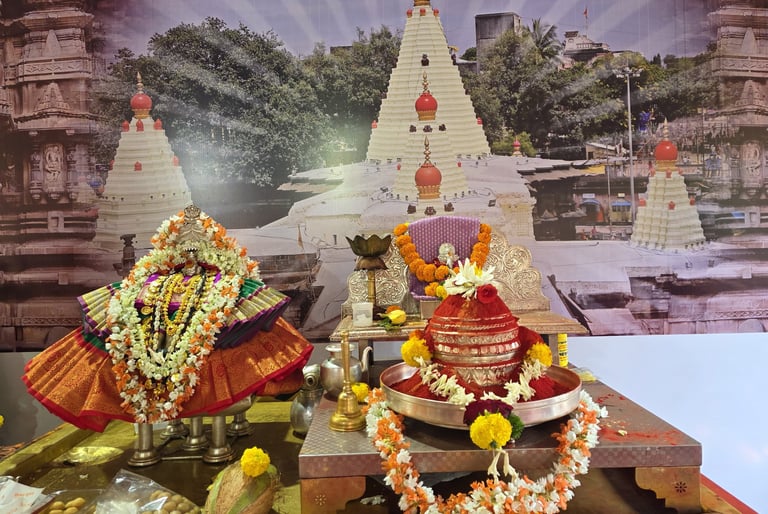
We headed next to the open Mandapam designed outside the temple, specifically for Abhishekam and Kumkumachara Pujas. There were multiple families who had booked that slot. The Abhishekam was done on an intricately beautiful silver Vigraha of Mahalakshmi with multiple Dravyas – Gangajal, Gulab Jal, Dadhi (Yoghurt), Ghritam (Ghee), Milk, Jaggery, Sugar, Mango juice, dry fruits followed by Ushnodakam (warm water). This was followed by Kumkumarchan on Devi’s silver Shri Yantra. We spent the next hour recapitulating the experience as Shri. Thanekar asked us to wait for him. After the hour, he asked us to come with him. We followed him and he took us to his house in an old part of the city. It was a traditional house which are called Wadas in Maharashtra. They housed multiple families, built traditionally from stone, wood and mud tiles for the roof. The vibe was peaceful, but the kitchen saw a lot of activity with as many as 5 women busy preparing lunch. The plates were laid for quite a few and then lunch was served in a typical Maharashtrian ‘Pangat’ – where the ladies of the house serve each food item in a sequence. With the Acharya blessing us with Bhagwati Annapurna’s Mantras, the lunch was the most divine I had ever experienced. We left Kolhapur that evening with our stomachs full, heart content and our minds with a calmness that was akin to a Night Lilly flower blooming on a Poornima.
Concept of Kuldevi
What did we learn from this Yatra? That Kuldevi or Aai in Marathi or Ambal in Tamil, is ever so compassionate. She always cares, nourishes, blesses and remembers her children, no matter even if the child forgets her. This is in stark contrast with Pitrus, who ignore and punish their next generations, if their Shraadha/Tarpana rituals aren’t done regularly.
Your ancestors didn’t have means of transport like you do in this age. Hence, Yatras to Shaktipeethas had to be undertaken with great risk for life. To circumvent these risks, they consecrated the local versions of these Devis. For instance, there are many Mahalakshmi Temples in remote villages of Maharashtra, all consecrated in the same image of the main Mahalakshmi at Kolhapur. As the Devata receives the Prana through the daily rituals, Naivedyam, Aarti, Japa and her Utsavas, they manifest their Krupa to not only the family who consecrated them but also to everyone in the vicinity of that temple.
So why is she specific to your clan/family/Kula? Remember the Sankalpa that we undertake for any Shubh Karya? It is taken with precise reference to the person’s Gotra, Name, Rashi and Varna. Adding to that the Panchangam and Desh Kaal – geography where it is taken, this confers the identity of that person’s lineage to the Devata. Speaking in scientific terms, the Seva done to the Devata is imbibed in the DNA of that Kula. How can you measure this? There’s a separate field of epigenetics, which explores the effects of external environmental factors on the DNA. I would explore the effects of these in a separate article. Coming back to Kuladevi, this is the reason why a specific family has specific ritualistic privileges at certain temples at certain places. It wasn’t random, it wasn’t illogical it was scientific precision blended with rituals to harness the power of the Nirguna.
Departure & Promise
We left Kolhapur with a promise to return every year, to let Amba know about our lives with its joys, sorrows, trepidations, issues and above all, her infinite grace which could never fade. Despite 4 decades of vestiges of her Seva, she remembered her children. She always calls for her children so that she could give them her Krupa. But are you listening? Do that and experience yourselves. - Sandeep S.Amberkar
2026 © Srividya Maha Samsthana. All rights reserved. Privacy Policy Terms and Conditions